


 Cart
Cart
 sales@molnova.com


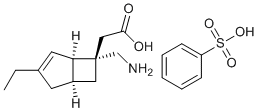
Mirogabalin besylate
CAS No. 1138245-21-2
Mirogabalin besylate( DS-5565 | DS5565 )
Catalog No. M10486 CAS No. 1138245-21-2
Mirogabalin besylate (DS-5565) is a novel potent, selective ligand of the α2δ subunit of voltage-gated calcium channels with Kd of 13.5/22.7/27.0/47.6 nM for huamn α2δ-1, human α2δ-2, rat α2δ-1 and rat α2δ-2 subunits, respectively.
Purity : >98% (HPLC)
 COA
Datasheet
HNMR
HPLC
MSDS
Handing Instructions
COA
Datasheet
HNMR
HPLC
MSDS
Handing Instructions
| Size | Price / USD | Stock | Quantity |
| 100MG | Get Quote | In Stock |


|
| 200MG | Get Quote | In Stock |
|
| 500MG | Get Quote | In Stock |
|
| 1G | Get Quote | In Stock |
|
Biological Information
-
Product NameMirogabalin besylate
-
NoteResearch use only, not for human use.
-
Brief DescriptionMirogabalin besylate (DS-5565) is a novel potent, selective ligand of the α2δ subunit of voltage-gated calcium channels with Kd of 13.5/22.7/27.0/47.6 nM for huamn α2δ-1, human α2δ-2, rat α2δ-1 and rat α2δ-2 subunits, respectively.
-
DescriptionMirogabalin besylate (DS-5565) is a novel potent, selective ligand of the α2δ subunit of voltage-gated calcium channels with Kd of 13.5/22.7/27.0/47.6 nM for huamn α2δ-1, human α2δ-2, rat α2δ-1 and rat α2δ-2 subunits, respectively; exhibits a slower dissociation rate for the α2δ-1 subunit than the α2δ-2 subunit compared to pregabalin; shows more potent and longer lasting analgesic effects in experimental neuropathic pain models, partial sciatic nerve ligation rats and streptozotocin-induced diabetic rats; inhibits rota-rod performance and locomotor activity in rats.Pain Phase 3 Clinical.
-
In VitroMirogabalin besylate is a ligand for the α2δ subunit of voltage-gated calcium channels, with Kds of 13.5 nM, 22.7 nM, 27 nM, and 47.6 nM for human α2δ-1, human α2δ-2, rat α2δ-1, and rat α2δ-2, respectively. Mirogabalin shows binding affinity for the gabapentin binding site in rat cortical brain homogenates with the IC50 value of 16.0 nM. Mirogabalin has no effect on any other receptors, channels, transporters, or enzymes at 50 μM.
-
In VivoMirogabalin besylate (3 and 10 mg/kg) markedly increases AUC0-8 hours values in a dose-dependent manner in partial sciatic nerve ligation model rats. Mirogabalin (2.5, 5, and 10 mg/kg) causes significant and dose-dependent increase in AUC0-12 hours values and enhances analgesic effects, with estimated ED50 of 4.4, 3.1, and <2.5 mg/kg on day 1, day 3, and day 5, respectively. Moreover, Mirogabalin besylate shows no obvious effect on rota-rod performance and locomotor activity at 3 and 10 mg/kg via oral administration, exhibits significant inhibition on rota-rod performance at 10, 30, and 100 mg/kg, and decreases locomotor activity at 30 and 100 mg/kg in rats.
-
SynonymsDS-5565 | DS5565
-
PathwayGPCR/G Protein
-
TargetCalcium Channel
-
RecptorCalcium Channel
-
Research AreaNeurological Disease
-
IndicationPain
Chemical Information
-
CAS Number1138245-21-2
-
Formula Weight367.46
-
Molecular FormulaC18H25NO5S
-
Purity>98% (HPLC)
-
SolubilityDMSO : 125 mg/mL 340.17 mM;
-
SMILESCCC1=CC2C(C1)CC2(CC(=O)O)CN.C1=CC=C(C=C1)S(=O)(=O)O
-
Chemical Name2-((1R,5S,6S)-6-(aminomethyl)-3-ethylbicyclo[3.2.0]hept-3-en-6-yl)acetic acid compound with benzenesulfonic acid (1:1)
Shipping & Storage Information
-
Storage(-20℃)
-
ShippingWith Ice Pack
-
Stability≥ 2 years
Reference
1. Merante D, et al. Pain Med. 2017 Nov 1;18(11):2198-2207.
2. Vinik A, et al. Diabetes Care. 2014 Dec;37(12):3253-61.
3. Domon Y, et al. J Pharmacol Exp Ther. 2018 Mar 21. pii: jpet.117.247551.
molnova catalog



related products
-
RU1968
RU1968 is a potent, cross-species sperm-specific Ca2+ channel CatSper inhibitor that is selective for CatSper over Slo3.
-
alpha-L-Rhamnose
Addition of the Rhamnose-rich polysaccharide RROP-1 to normal human dermal fibroblasts (NHDFs) and human endothelial cells produced a dose-dependent stimulation of the calcium-signaling pathway inducing fast and transient increases in Ca2 influx and intracellular free Ca2 level.
-
Efonidipine hydrochl...
Efonidipine (NZ-105) is a potent, dual T-type and L-type calcium channel blocker.
